Monday, March 15, 2010
Experimentation
I was toying with the idea of making 3 small, really small, canvases & on them showing this progression of legacies & the role of women, down the line of women in my family, from my great-grandma to me. The first canvas would posses the legacy and heirlooms of my grandma. The second canvas would show my mummy's legacy. And the final canvas will be me, showing how their have shaped me & maybe what legacy i wish to create. Each canvas will have rhizomes, showing our connection though the generations.

Rhizomes
In philosophy, the term rhizome has been used a both a metaphor & a concept, & refers to the botanical rhizome, which is the roots of plants that grow underground in long strands.
Carl Jung used the word 'Rhizome' to emphasize the invisible & underground nature of life. Rhizomes were a concept we explored in Year 10 in our Serendipity unit. I want to use Rhizomes in some of my body of work to show the connection of my family generations, I want to use them to show that although through each generation of the women in my family there have been progressions in values & their roles & the legacies, that they all all connected underneath. I want to show that some values or roles run constant through the generations, also showing that the latest generation is the product of the past.
Carl Jung used the word 'Rhizome' to emphasize the invisible & underground nature of life. Rhizomes were a concept we explored in Year 10 in our Serendipity unit. I want to use Rhizomes in some of my body of work to show the connection of my family generations, I want to use them to show that although through each generation of the women in my family there have been progressions in values & their roles & the legacies, that they all all connected underneath. I want to show that some values or roles run constant through the generations, also showing that the latest generation is the product of the past.
Christo
& the late Jeanne-Claude
"Wrapped Coast, Little Bat, One Million Square Feet, Sydney, Australia, 1968-69"
"Wrapped Coast, Little Bat, One Million Square Feet, Sydney, Australia, 1968-69"


Here are their first sketches of the idea, i would like this kind of look to come through in my sketches. i like how delicate they look. I also like this sketch with the blue in it, i want only small bits of colour in my sketches.
Here are the photos of the finished work.


Monday, March 1, 2010
Sharon Green
I was rather drawn to these photographs of Green's. Although i wouldn't say that the concept of her work relates very closely to my ideas, i do think they relate on some level. She explores the hobby of hunting & in the image 'Never Hunting' she shows the hunted deer head on the natal piece showcased as a prize. The deer head is put up on the mantelpiece as an object of value, showcasing the effort that was put behind it being there. i think that this relates to the ideas i want to explore, as we work out whole lives, evolving, gaining knowledge, changing our values & beliefs, & our legacies are the only remaining aspect of that work in our lives when we pass on. Our legacies are kind of like the deer head on the mantelpiece.
Monday, February 15, 2010
Alice Lang
" I was interested in redefining he relationship/border between traditional wearable objects & the body,  through the creation of fleshy wearable pieces (reminiscent of period clothing) that integrate & interact with the subject. Bonnets and bustles mutate, grow tendrils & attach themselves to their host like a strangler fig, overtaking their body to form a new decorative flesh." Alice Lang

Lang's practice explores the possibilities for sewn sculpture to explore, & complicate, the relationships between concepts of the decorative & the grotesque, particularly their association with depictions of femininity. To so this she uses traditional sewing technique known as the Suffolk Puff to reference the use of old techniques in the creation of t new objects/organisms that are a hybrid of the craft.
 through the creation of fleshy wearable pieces (reminiscent of period clothing) that integrate & interact with the subject. Bonnets and bustles mutate, grow tendrils & attach themselves to their host like a strangler fig, overtaking their body to form a new decorative flesh." Alice Lang
Lang's practice explores the possibilities for sewn sculpture to explore, & complicate, the relationships between concepts of the decorative & the grotesque, particularly their association with depictions of femininity. To so this she uses traditional sewing technique known as the Suffolk Puff to reference the use of old techniques in the creation of t new objects/organisms that are a hybrid of the craft.
I am so intrigued by the way that by altering the materials with which Alice Lang constructs the typically feminine clothing articles, she is able to change the meaning of the clothing pieces. 
Legacy
"A legacy or legacies, is what someone or something is remembered for or what they have left behind that is remembered, revered or has impacted current events and the present day."
We are now at a time when we are leaving school & are trying to decide what we want to do when we enter in to the big, wide world. Something to consider is what mark we want to leave on this school & on the world during our adult life. When I ponder this, I think about what the legacy was of my Ninny (my great grandmother), what my Nana's would be & what mine will be. When looking at this, you can see clearly the change of the role of women within our family & in society. You can also see the change in values, & the consistency of values within the family. I would like to explore this changing role of women in my body of work.
History: Exploring the Past & the Present
I would, with this first body of work. like to explore working in a bit of a historical context. I like delving into the past, particularly my families pasty. I would like me body of work to act as a kind of window to the past. I want to look at the idea of family heirlooms, particularly down the female side of the family. Heirlooms can be very telltale of the life of the personal who first possessed them. The items that my grandmother is passing down are things like recipes of the family, dancing items, 'ancient' music sheets and precious jewellery. This allows you very easily to denote that her role in life was firstly a mother, & that creativity was also large in her life, which is true. When given an heirloom, someones legacy in this world, it makes you think of what legacy you want to leave behind, & what role you want to be know for.
Art is a vessel embodying both creation & communication
I think that the above excerpt form the task sheet truly expresses the purpose of art making, at least what its purpose is to me. I truly see the purpose of my art making as a way to communicate in a way that is non-verbal (in most of my cases) & allows me to be creative. I think that this is an idea that I will keep close to me during my final year of art at school.
I think that last year, especially in semester 2, was the first real time that I created artworks that were expressing something of my inner self & my inner thoughts. I think that finally getting the opportunity to begin to do that with my art made me enjoy art a lot more.


Alchemy
Alchemy can be used as a metaphor for the art making process.
Through engaging with a process of alchemy a personal aesthetic can be defined.
Through engaging with a process of alchemy a personal aesthetic can be defined.
The oxford dictionary defines Alchemy as being:
"the medieval forerunner of chemistry, concerned with the transmutation of matter, in particular with attempts to convert base metals into gold or find a universal elixir"
h
In relation to art, I think that Alchemy can be viewed more as a journey or a process through which knowledge or understanding is gained. This could be knowledge of self, or self understanding.
It could also be seen as the way by which something is made to become more valuable or to become seens as being of a greater value. It could further more be percieved as the process through which the culmination of things of lesser value seperately are combined to become of a greater value or importance.
Wednesday, August 20, 2008
Tuesday, July 15, 2008
My Chosen Vanita is...

I chose this Vanita for a number of reasons. The main reason for choosing it was that i though it would be easier to paint because it has less going on. I also had this idea of my objects/symbols being on the desk around the pocket watch creating a "cluttered desk" effect, much like my desk at home. I also think that because it's more simplistic, I think it will be easier to complete on time, providing I put the effort in.
My Chosen Symbols
I have finally chosen the objects that I will include in my Vanita.
My Birth Bracelet: I have decided to use my birth bracelet as one of my symbols for the simple reason that it is very important to me. I have had it since birth and it has great sentimental value to me, so I think that it's use is appropriate. These items are meant to represent us, and the bracelet represent the journey of my life.
My Oval Box: My oval box is a gift that I received some years ago that I use to keep little, special item in. Once again, it means alot to me, so i thought i should use it.
My iPod Headphones: My 3rd and final item that I plan to put in the Vanita is my iPod headphones. I listen to m iPod all the time, so i think that they deserve a spot in my Vanita. I also feel that music is a great and powerful way to express yourself, and is a way in which I express myself. This also prompted my want to include the headphones as they represent the music.
My Birth Bracelet: I have decided to use my birth bracelet as one of my symbols for the simple reason that it is very important to me. I have had it since birth and it has great sentimental value to me, so I think that it's use is appropriate. These items are meant to represent us, and the bracelet represent the journey of my life.
My Oval Box: My oval box is a gift that I received some years ago that I use to keep little, special item in. Once again, it means alot to me, so i thought i should use it.
My iPod Headphones: My 3rd and final item that I plan to put in the Vanita is my iPod headphones. I listen to m iPod all the time, so i think that they deserve a spot in my Vanita. I also feel that music is a great and powerful way to express yourself, and is a way in which I express myself. This also prompted my want to include the headphones as they represent the music.
Narrowing Down The Choices
As well as deciding which symbols to include in my Vanitas, I also have to choose which Vanitas I will use.
After much consideration, I have narrowed down my choices to the following two:
 I particularly like this Vanita. I like how it contains many different objects that are all packed together onto the shelves. I think that it would be interesting to place my own items in this painting, and I also feel there are a lot of opportunities to do so. On the other hand, this piece, I think, would be very complicated to paint on the canvas. I think that I would struggle getting the scale and shape of the objects within the image.
After much consideration, I have narrowed down my choices to the following two:
 I particularly like this Vanita. I like how it contains many different objects that are all packed together onto the shelves. I think that it would be interesting to place my own items in this painting, and I also feel there are a lot of opportunities to do so. On the other hand, this piece, I think, would be very complicated to paint on the canvas. I think that I would struggle getting the scale and shape of the objects within the image.
  This Vanita I also like. I think that it would be quite easy to insert my objects and symbols into the Vanita as objects on the desk around the pocket watch. I also think that this Vanita would be challenging to paint, but not overly difficult and time consuming to complete. I also think that the scale would be easier to keep.
Appraising Task Practice
Here are my practice Appraising Tasks for my assessment.


This artwork is called “38 Degrees” by Ben Quilty. The piece is oil on canvas, completed in 2006. The piece depicts a baby’s face which has a hard, strong expression that makes it look like it is concentrating. It also gives the idea of a temperamental baby. Around the outline of the baby’s head and smudging out from it is a warm red against the white background. Together the piece evokes an emotion that is hard, strong and bold. To create these emotions the artists utilises some of the elements and principles of visual language. One of the elements that stand’s out when the piece is first viewed is texture. The surface quality of the artwork appears to be rough, like it could actually be felt. This looks to have been achieved by the thick, rough application of the paint causing the raised edges. This texture of raised edges has aided the emotion of the piece by emphasizing the lines of the baby’s face and determining the facial features. Line was another element used. The element of line in the artwork has several different uses. The artist has used line to show the emotion in the baby’s face and show the movement of the face. At the eyebrow and forehead above the right eye the artist has used lots of thick brush strokes showing the frowning of the baby. The direction of the brush strokes work out from a fan in the top right hand of baby’s head where the dark purple is used. This also aids the creation of a focal point because the dark purple strongly contrast with the warm red and the white. The thicknesses of the lines also create a sense of the emotions weight, as is the baby is carrying a heavy emotion. Colour is another strongly used element in the piece. The artist has used warm contrasting colours, including pinks, browns, purples, and reds. These are all harmonious colours but they still create a contrasting effect. The contrast of the pinks and purples of the face and the red in the background create an emphasis that makes the face look like it is being pushed forward in an angry way. Kind of like the baby is coming at you. The tone of the colours incorporates both light and dark. This too emphasizes the focal point. I think that the artist might be trying to express the strong emotions that a baby can feel; tiredness, happiness and moodiness. I think that in this particular piece the artist is expressing the baby as being temperamental. The look on the baby’s face is that of a baby that is sitting there, looking up at you because you won’t do something for it.

This artwork is called “Michael and I are just slipping down to the pub for a minute” by Lin Onus. The piece depicts a dingo on top of a stingray riding a wave in the ocean. In the background the sky is fading red to yellow representing the sunset. Together the piece evokes a calm emotion. The waves are big and look to be crashing but the stance of the dingo and the sunset bring forth the calm and relaxed feeling. To create these emotions and feeling the artist makes use of some of the elements and principles of visual language. The emotion of calm against the crashing wave is created by the use of colour. The background consists of warm reds, oranges and yellows blending and fading from the top of the page to the bottom. These contrasts of the warm colours against the cold blues of the ocean create the relaxed atmosphere. The artist also uses the element of line to create movement in the piece. The waves are made to look as if they are moving from the left of the page to right of the page because of their striping. The waves are painted in lines of dark and light cold blues. The shape of the wave itself also creates the movement as they all curve to the right. The direction the stingray and the dingo also add to this movement, facing the right of the piece. This also works to harmonise and balance the piece as the focal point is in the left. Having them facing the right add to that half, thus creating balance. I think that the meaning behind this piece intended by the artist is the struggle of the indigenous person. The dingo and the stingray have aboriginal markings, and the name of the piece is “Michael and I are just slipping down to the pub for a minute”. This artwork shows the struggle that the indigenous man has to go through to get to the pub; a place of relaxation. The harsh waves that the animals have to ride represent this struggle, with the sunset showing the goal, to get to a comfortable, relaxing place.
Analysing Artwork
Part of our art assessment for Term 2 involved us having to analyse an artwork.
When analysing artworks, we learnt that there is a simple method that we can follow:
D.A.I.J.
Describe: What so you see?
Analyse: Discuss the visual language.
Interpret: What is the message? Justify using evidence from the visual language.
Judge: Is the artist successful in getting their message across?
When analysing artworks, we learnt that there is a simple method that we can follow:
D.A.I.J.
Describe: What so you see?
Analyse: Discuss the visual language.
Interpret: What is the message? Justify using evidence from the visual language.
Judge: Is the artist successful in getting their message across?
Me
This Vanitas task requires us to contemplate what objects, animals or symbols represent us. I find this rather hard. At the moment I'm just thinkning material possesions and I am struggling to find anything more than that. Hopefully I will be able to. Here is the list at this current stage:
> candle
> my teddy bear
> my gold baby bracelet
> iPod
> my artist book from last year
> Havianas
this list is to be continued...
> candle
> my teddy bear
> my gold baby bracelet
> iPod
> my artist book from last year
> Havianas
this list is to be continued...
Sunday, June 15, 2008
Vanitas
In the arts, Vanitas, is a stpe of symbolic still life painting commonly done by Northern European painters in Flanders and the Netherlands in the sizteenth and seventeenth centuries.
The term, Vanitas itself refers to the arts, learning and time. The word is latin, meaning "emptiness"
Paintings executed in the Vanitas style are meant as a reminder of the transience of life, the futility of pleasure, and the cartainty of death, encouraging a sombre world view. Common Vanitas symbols include skulls, reminder of death; rotten fruit, representing decay like ageing; bubbles, which symbolise the brevity of life and the suddeness of death; smoke, watches and hourglasses; and musical instruments, symbolizing the ephemeral mature of life.
My Serendipity Piece
This is my final Serendipity piece...

This unit, i thin has been about the concept of finding self, and life, and working with the cards you've been dealt. Our art piece for this unit was an ink work which we worked over in pencil creating rhizomes and mandalas, and becoming our very own Andy Goldsworthy. This piece really made me contemplate and reflect upon the ideas that had been presented to us during the unit, as in our final piece we were to create a symbol of self - and that is what the mandalas and rhizomes are all about.
Before we created the final, we originally practised the inks on smaller paper so that we could get somewhat of a handle on the inks. There were multiple ways in which we could apply the inks. For one of them, we immersed the paper in water in a tray, then pulled it out and let the water drain off it. We then dropped the ink onto the wet paper and then let it spread. From there we could just leave it, or we could manipulate the paper to make the ink run in certain directions. We could also add multiple colours of ink. Another technique that we practised was spraying the paper with water and then dropping the ink. We could also spread the ink by blowing it with a straw, instead of moving the paper.
For my final piece, I used a combination of the techniques. I mostly sprayed the paper with water and then added the inks. To move the ink I manipulated the paper, and i used a straw. The one and only thing that i found frustrating about the concept of Serendipity, was the lack of control you had over the outcome.
 These are some close up images of my final piece, courtesy of Mrs Vincent.

Mandalas & Rhizomes
For our final Serendipity piece we have to draw in Mandalas & Rhizomes, working with what the ink has created.
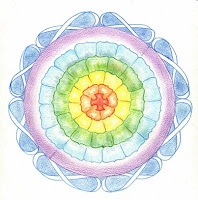


Mandalas...
The word "Mandala" is loosely translated to mean "circle". A mandala is far more than a simple shape. Mandalas represent wholeness, and can be seen as a model for the organizational structure of life itself - a cosmic diagram that reminds us of our relation to the infinite, the world that extends both beyond and within our bodies and minds.
Mandalas appear in all aspects of life: the celestial circles we call earth, the sun, and moon, as well as conceptual circles of friends, family and community.
"The integrated view of the world represented by the Mandala, while long embraced by some Eastern religions, has now begun to emerge in Western religious and secular cultures. Awareness of the Mandala may have the potential of changing how we see ourselves, our planet, and perhaps even life."


Rhizomes...
In philosphy, the term Rhizome has been used as both a metaphor and a concept, and refers to the botanical Rhizome. The botanical Rhizome is the roots of plants that grow underlground in long strands.
Carl Jung used the word "rhizome", also calling i a "myzel", to emphasize the invisible and underground nature of life:
"Life has always seemed to me like a plant that lives on its rhizome. Its true life is invisible, hidden in the rhizome. The part that appears above the ground lasts only a single summer. Then it withers away - an ephemeral apparation. When we think of the unending growth and decay of life and civilisations, we cannot escape the impressions of absolute nullity. Yet I have never lost the sense of something that lives and endures beneath the eternal flux. What we see is blossom, which passes. The rhizome remains."
Subscribe to:
Posts (Atom)

